Do you need a burn permit in Florida?
Sometimes. A Florida burn permit is officially a burn authorization, issued by the Florida Forest Service (FFS). You need one for land clearing, agricultural, silvicultural, pile and acreage burns, and for any pile wider than 8 feet. A smaller yard waste pile needs none if it meets the setbacks and hours and no local ban applies.
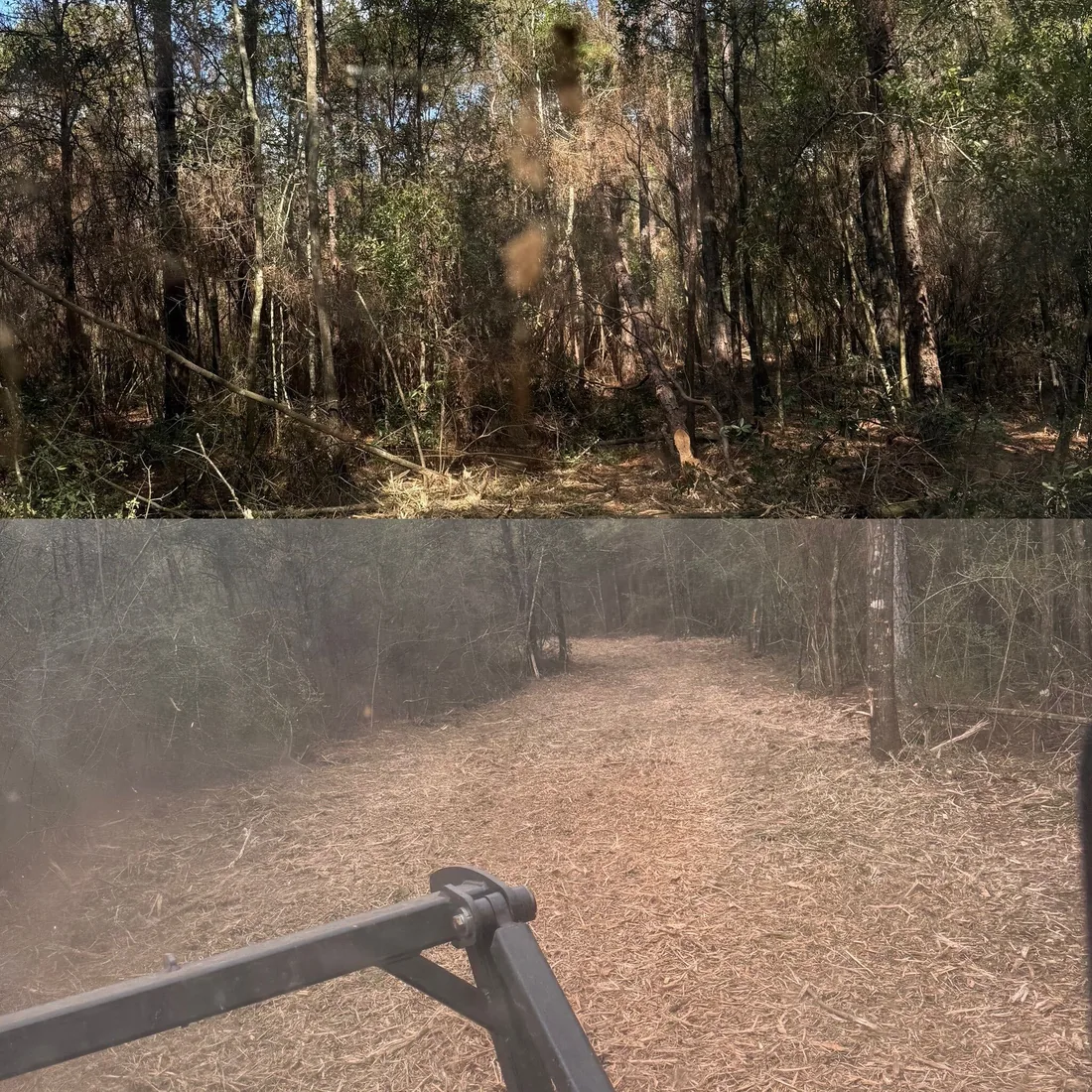
There is also a way around the question. Brush from clearing can be ground in place with forestry mulching, which leaves no pile to burn.
What burns need a Florida Forest Service authorization?
Five kinds of burning need an FFS authorization: agricultural, silvicultural, land clearing, pile and acreage burning. Size matters too. Any pile greater than 8 feet in diameter needs an authorization, and you must have suppression equipment on hand.
Land clearing has a narrow meaning here. The FFS defines it as clearing tied to construction of buildings or roads, land development or mineral operations. Its FAQ notes that many people link the term to clearing palmetto and gallberry bushes from their own property.
The FFS splits land clearing burns in two. Residential means clearing for an existing or planned home site of no more than two family units. Any other land clearing debris counts as non-residential.
A burn authorization covers the fire only. The clearing itself can need a county permit, which our Florida land clearing permit guide covers county by county.
When can you burn yard waste without an authorization?
Yard waste needs no FFS authorization if the pile is under 8 feet across and meets the setbacks and hours. The fire must be lit after 8 a.m. Central Time or 9 a.m. Eastern Time. It must be out one hour before sunset.
The pile must sit 25 feet from forests and 25 feet from your house. It needs 50 feet from paved public roads and 150 feet from other occupied buildings. The FFS adds that the yard waste must be generated on your property, and the exemption holds only where no local, city or county ordinance prohibits burning.
Yard waste means plant debris from yard upkeep, such as grass clippings, brush, leaves, tree limbs and palm fronds. The FFS suggests clearing an area down to bare soil around the pile to keep the fire from spreading.
How do you get a burn authorization in Florida?
Call your local FFS office after 4 p.m. the day before the burn or on burn day. The request works by phone, so there is no need to drive to the office. Each burner should use their own customer number, which the FFS says is free and easy to get. For Santa Rosa, Escambia and Okaloosa Counties, the FFS district headquarters is the Blackwater Forestry Center.
The duty officer locates the burn by its Section, Township and Range, which is usually on your deed. That narrows the spot to a 1 mile by 1 mile area. You also give the purpose of the burn, plus your address if you have no account set up. Depending on the purpose, the duty officer may tell you how far the fire must be from homes and roads.
An authorization covers one location and one day of burning. A second day needs a new call, unless the FFS issued an extended authorization for up to three days.
State law adds its own conditions in section 590.125. The landowner must consent, and the site needs adequate firebreaks plus enough people and equipment. The fire must stay inside the authorized area, with the person named responsible on site until it is completed. The FFS must also find air quality and fire danger favorable.
How far from houses and roads does a burn need to be?
Florida’s setbacks depend on the burn type. A small yard waste pile needs 25 feet from your house. Non-residential land clearing needs 1,000 feet from occupied buildings.
| Burn type | FFS authorization | Setbacks | Hours |
|---|---|---|---|
| Yard waste pile under 8 feet | Not required | 25 feet from forests and your house; 50 feet from paved public roads; 150 feet from other occupied buildings | Light after 8 a.m. Central or 9 a.m. Eastern; out one hour before sunset |
| Pile over 8 feet | Required, with suppression equipment on hand | Additional setbacks from your local FFS field unit | 8 a.m. Central or 9 a.m. Eastern to one hour before sunset |
| Agriculture or silviculture pile | Required | 300 feet from occupied buildings; 100 feet from roads; 50 feet from wildlands, brush or combustible structures | 8 a.m. Central or 9 a.m. Eastern to one hour before sunset |
| Residential land clearing | Required | 300 feet from occupied buildings; 100 feet from roads; 50 feet from wildlands, brush or combustible structures | 8 a.m. Central or 9 a.m. Eastern to one hour before sunset |
| Non-residential land clearing | Required | 1,000 feet from occupied buildings; 100 feet from paved public roads; 100 feet from wildlands, brush or combustible structures | 8 a.m. Central or 9 a.m. Eastern to one hour before sunset |
| Air curtain incinerator | Required for land clearing debris | 300 feet from occupied buildings; 50 feet from wildlands, brush, combustible structures or paved public roads | Start after 8 a.m. Central or 9 a.m. Eastern (after sunrise with refractory-lined walls); done by one hour after sunset |
Florida law counts stacked land-clearing debris from the site as pile burning, windrows included. Certified pile burners may burn until one hour after sunset, except in areas the FFS designates as smoke sensitive. The duty officer tells you when your site is in one. An air curtain incinerator is a specially designed machine that burns debris quickly with little or no smoke.
What can never be burned in Florida?
Household garbage can never be burned in Florida, and that includes paper products. The FFS list also bars treated lumber, plastics, rubber, tires, pesticide, paint and aerosol containers. In pile burning, Florida allows nothing but naturally occurring vegetation.
Wet vegetation is a poor choice, too. The FFS says burning wet material makes a lot more smoke and burns inefficiently. So right after a rain is a bad time to burn, even when it feels safe.
Is there a burn ban in Santa Rosa, Escambia or Okaloosa County?
Check before every burn, because county governments enact local burn bans. The FFS posts a County-Enacted Burn Ban Map on its Current Wildfire Information page. That map reflects the bans counties report to the FFS.
Counties are not required to tell the FFS when they start or lift a ban. For a sure answer, the FFS says to call the local city or county fire department. Some cities and counties have rules of their own, and some may not allow any burning at all.
Escambia County posts its own outdoor burning rules on its Burning Safely Outdoors page. That page allows dry, not green, vegetative debris in a pile no larger than 8 feet across. The burn runs between 8 a.m. and one hour before sunset. The county also says to check the burn area over the next several days.
Across the state line, Alabama runs its own burn permits through the Alabama Forestry Commission. Our Alabama burn permit guide covers those rules for lower Alabama.
What is the penalty for burning without an authorization?
Breaking the authorization rules in section 590.125 during a pile or broadcast burn is a second-degree misdemeanor. Section 775.083 sets $500 as the fine limit for that class, with higher amounts allowed in some cases. Burning outside the authorized location can also bring a fine from the FFS or the city or county.
The FFS warns that an escaped fire can leave you liable for suppression costs and damage to others’ property. Escaped debris burning is one of the leading causes of wildfires in Florida, the FFS says.
Can you skip the burn pile altogether?
Yes. Grinding brush in place leaves no pile, so Florida’s burn rules never come into play. The FFS lists mechanical treatment, or mowing, as a fuel reduction technique for homes next to heavy wildland fuel. It does not eliminate the fuel, but it reduces the volume and puts it on the ground.
Grinding brush in place is the work Clearview Contracting Solutions does. Our skid steers run forestry mulcher heads that grind brush and small trees into chips where they stand. On wooded lots, underbrushing grinds the palmetto and brush under the pines and oaks you keep. When the goal is a building site, land clearing takes the ground to a buildable or usable state.
We give free on-site estimates with a written number across Northwest Florida and lower Alabama. If you would rather skip the burn pile, contact us or call (850) 910-2447.